

Last Updated: November 2, 2026
Quick Summary
Knee pillows may help side sleepers with positioning-related discomfort, but they are not a cure for joint pain, and the research does not yet prove they work for everyone. Whether a knee pillow works for you depends on whether it keeps your hips stacked and your knees comfortable. A fair test takes about two weeks of consistent use with one change at a time.
- Knee pillows support alignment and may ease pressure on the back and hips.
- Place the pillow between the knees at knee level, not above or below them.
- Check that your hips feel stacked rather than twisted forward or backward.
- Adjust thickness before position: thinner if knees split too far, thicker if the top knee drops.
- Track a baseline, change one variable at a time, and test for at least two weeks.
Table of Contents
- What Research Says About Whether Knee Pillows Work
- Benefits of Sleeping With a Pillow Between Your Knees
- How to Use a Knee Pillow Step by Step
- Knee Pillow Positioning for Side, Back, and Stomach Sleepers
- Sleeping With a Pillow Under Your Knees: When It Helps and When It Doesn't
- Who Should Check With a Doctor First
- Trying a knēNest Knee Pillow for Two Weeks
- Frequently Asked Questions
What Research Says About Whether Knee Pillows Work
Knee pillows may help with positioning-related discomfort, but they are not a cure for joint pain. That distinction matters when you decide whether a knee pillow is right for you.
The evidence is thin. Healthline points out that there is not much scientific research specifically on knee pillows, even though they may help keep the spine and hips aligned.
Physical therapists generally describe knee pillows as a way to support alignment. Verywell Health cites one physical therapist who says knee pillows can help reduce back pain during sleep by improving lower-body and spinal alignment.
Some sources question whether traditional knee pillows keep the hips in a natural position.
The honest answer is this: a knee pillow may make side sleeping more comfortable for some people, but the research does not yet prove it works for everyone.
Benefits of Sleeping With a Pillow Between Your Knees
A pillow between the knees is meant to keep the upper leg from dropping onto the lower leg while you sleep on your side. When the top knee rests on the bottom knee, the hips can rotate and the lower back can twist slightly. A knee pillow fills that gap.
People who sleep on their sides often report a few practical benefits:
- Less knee-on-knee pressure. The top knee sits on a soft support instead of pressing down on the lower knee.
- Better hip position. The pillow can help the hips stay stacked rather than rolling forward.
- Easier spinal alignment. Keeping the legs level may reduce twisting through the lower back.
- Fewer position changes. Some people toss and turn less when their legs feel supported.
These benefits are reported by users and experts, not proven in large trials. If you notice comfort gains, that is a good sign. If you notice none after a few weeks, a knee pillow may not suit your sleep style.
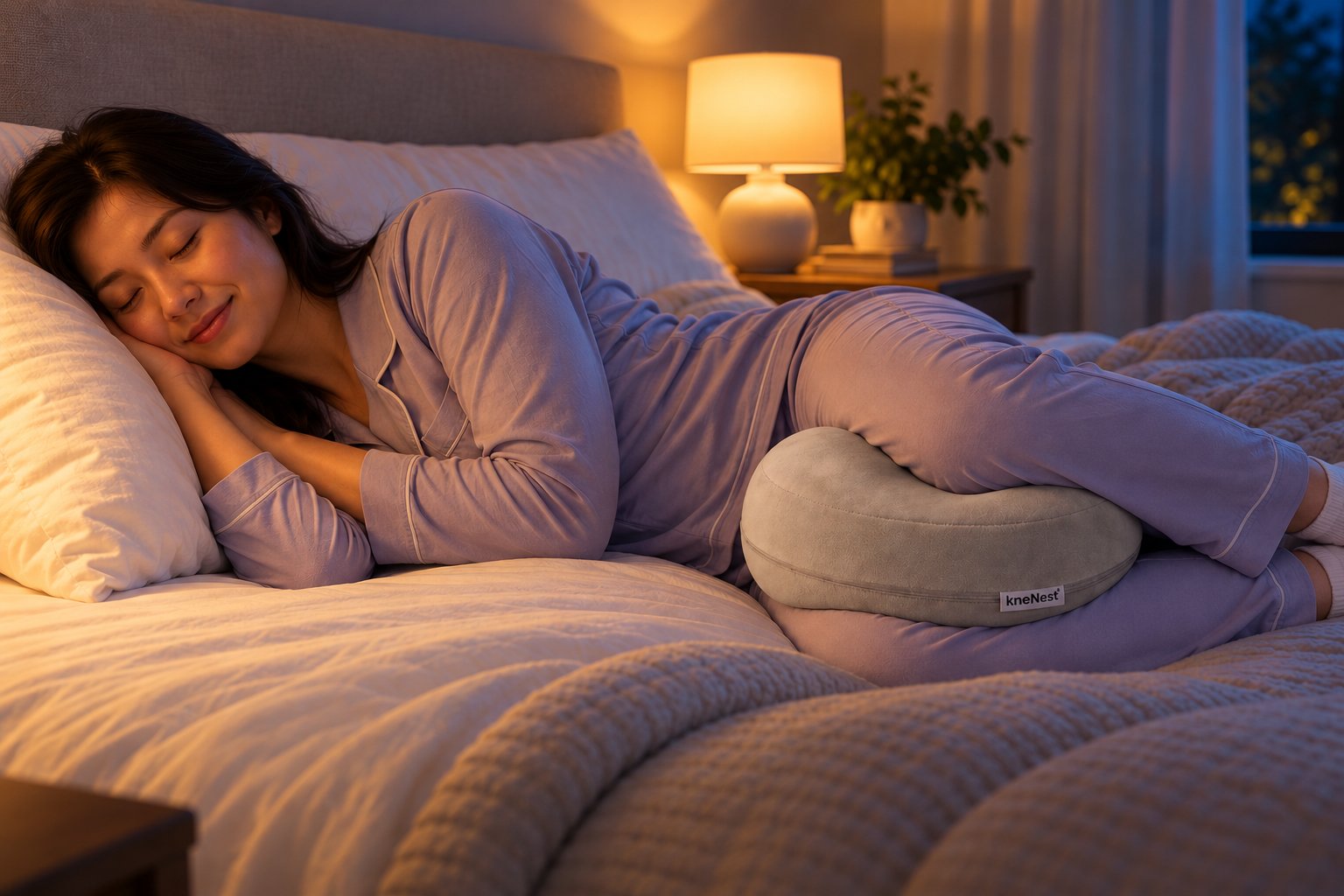
The knēNest Side Sleeper Alignment Knee Pillow is designed for this purpose, with a contoured shape that cradles both knees. You can learn how the knēNest side sleeper pillow is designed if you want a closer look at the fit.

How to Use a Knee Pillow Step by Step
Using a knee pillow correctly makes a big difference. Most people get better results when they follow these steps, but the details matter more than the sequence.
- Start on your side in your usual position. Lie on the mattress the way you normally fall asleep. Do not force a new posture before you have tested the pillow.
- Bend the top knee slightly. A small bend, roughly 15 to 30 degrees, lets the upper leg rest naturally on the pillow without pushing the hip out of line.
- Place the pillow between the knees, not above or below them. The cushion should sit snugly at knee level so the top knee rests on it rather than pressing into the bottom knee.
- Check your hip stack. Your hips should feel stacked, not twisted forward or backward. If the top hip rolls forward, the pillow is likely too thin or positioned too low.
- Adjust thickness before you adjust position. If your knees feel pushed too far apart, try a thinner pillow or a partial fill. If your top knee still drops, try a slightly thicker option.
- Stay in position for a few minutes. Notice whether your legs and lower back feel more relaxed. If you feel pressure behind the knee or at the hip, reposition before you try to sleep.
A common pattern is that people place the pillow too high, near the thighs, which separates the legs but does not support the knee joint itself. Others use a pillow that is too thick, which can push the hips out of alignment and create new strain.
If the pillow slips during the night, a pillow with a contoured shape can help it stay in place.
Expect an adjustment period. Your body may need several nights to get used to a new position. Do not judge the pillow after one night, and do not assume that more thickness is better.
The steps below summarise how to set up a knee pillow and what to check at each stage.
Step |
What to do |
Time or frequency |
|---|---|---|
Start on your side |
Lie in your usual sleeping position |
Before adding the pillow |
Bend the top knee |
Bend it slightly, about 15 to 30 degrees |
Every night |
Place the pillow |
Set it between the knees at knee level |
Every night |
Check hip stack |
Hips should feel stacked, not twisted |
A few minutes after setup |
Adjust thickness |
Thinner if knees split too far, thicker if top knee drops |
Over several nights |
Stay still briefly |
Note whether legs and lower back feel relaxed |
A few minutes before sleep |
Knee Pillow Positioning for Side, Back, and Stomach Sleepers
Knee pillows are designed mainly for side sleepers, but the setup changes depending on how you sleep.
Side sleepers get the most direct benefit. Place the pillow between the knees and keep the hips and shoulders in a straight line.
knēNest Side Sleeper Alignment Knee Pillow – Patent Pending →
Back sleepers can use a knee pillow under the knees rather than between them. A small support under the knees can reduce strain on the lower back. Keep it low so the spine stays neutral.
Stomach sleepers generally do not need a knee pillow. Lying face down often twists the spine, and adding support under the hips or pelvis is more useful than a knee pillow. Persistent discomfort in the joints might also lead some to consider whether cold compression sleeves offer a viable alternative for managing inflammation after a long night of restless positioning.
Whatever your position, the goal is the same: keep the spine and hips in a neutral line and avoid twisting.
Sleeping With a Pillow Under Your Knees: When It Helps and When It Doesn't
A pillow under the knees, as opposed to between them, is a common recommendation for back sleepers. It can reduce pressure on the lower back by slightly bending the knees. Many people find this more comfortable than lying with straight legs.
It helps less when the pillow is too thick. A high pillow can push the hips out of line and create new strain. It also does little for side sleepers who need support between the knees.
Results also depend on the cause of your discomfort. For a deeper, practical guide, see how to prevent knee pain while sleeping. A knee pillow may ease pressure from poor positioning, but it will not address pain from injury, arthritis, or nerve problems. If your discomfort persists after a few weeks of consistent use, change your approach rather than waiting longer.
Who Should Check With a Doctor First
A knee pillow is a comfort and positioning product, and some people should speak with a doctor or physical therapist first:
- People with sciatica, numbness, or pain that shoots down the leg
- Anyone recovering from knee or hip surgery, who may need specific positioning instructions
- People with chronic joint conditions such as arthritis
- Anyone whose back or hip pain worsens or does not improve after a few weeks
A healthcare provider can tell you whether a knee pillow fits your situation and whether other support, such as physical therapy, would help more. A knee pillow supports comfort and positioning. It does not replace medical care.
Trying a knēNest Knee Pillow for Two Weeks
If you want to test whether a knee pillow works for you, a simple two-week plan gives you a fair result. The key is to track what changes and to adjust one variable at a time.
Before you start: Note your current sleep pattern for two or three nights without the pillow. Write down how often you wake, whether you feel stiffness in your hips or lower back in the morning, and any knee-on-knee pressure you notice. This baseline makes it easier to judge whether the pillow helps.
Week 1, Establish the position. Use the pillow every night in your usual side-sleeping position. Keep the rest of your sleep setup the same, same mattress, same room temperature, same bedtime, so you are testing the pillow, not a new routine. Each morning, note:
- How many times you woke during the night
- Whether your knees, hips, or lower back felt different from your baseline
- Whether the pillow stayed in place or needed repositioning
Week 2, Adjust one thing. If the pillow felt too thick or too thin, try a different thickness or a slight change in position. Do not change multiple factors at once.
Decide: At the end of two weeks, compare your notes to your baseline. If you notice clear improvement in comfort or fewer position changes, the pillow is likely a good fit. If you notice no difference, or if your discomfort worsened, you have learned something useful without guessing.
A common pattern is that people judge a knee pillow after one night or after a single poor night's sleep. Two weeks gives your body time to adjust to the new position and gives you enough data to make a fair decision.
The knēNest Side Sleeper Alignment Knee Pillow is available with a 60-night comfort trial, so you can test it over a longer period than two weeks. You can see the knēNest side sleeper knee pillow and decide whether it fits your sleep style.
For a broader view of knee pillows, read our guide on why side sleepers need knee support. If you are weighing whether the purchase is worth it, this comparison of knee pillow options can help you decide.
Frequently Asked Questions
Do knee pillows actually work for back pain?
The evidence is limited. The National Council on Aging says a knee pillow may help with joint pain caused by sleep positioning, but it will not cure the underlying problem. A physical therapist quoted by Verywell Health similarly says knee pillows can support lower-body and spinal alignment during sleep. Many people find that keeping the knees separated reduces strain on the lower back, but results vary. If back pain is persistent or worsening, speak with a doctor or physical therapist before relying on a pillow alone.
Do knee pillows help side sleepers feel more comfortable?
For many side sleepers, a pillow between the knees keeps the top leg from dropping forward and pressing on the bottom knee. That separation can make lying on the side feel more stable and less tiring over the night. The knēNest Side Sleeper Alignment Knee Pillow is designed for this position, with a contoured shape that cradles both knees. Comfort depends on body size, mattress firmness, and personal preference, so give any pillow a fair trial before deciding.
How should you position a pillow between your knees?
Lie on your side with your bottom leg straight or slightly bent. Place the pillow between your knees so the top knee rests on the pillow and your upper leg is supported. Keep the pillow high enough to fill the gap between your knees without forcing them apart. Check that your hips stay stacked rather than rolling forward or backward. Adjust after the first few nights until the position feels settled rather than strained.
