

Side Sleepers Over 40: Your Knees May Be Pulling Your Hips & Spine Out of Alignment — And You Don't Feel It Happening
If you wake up stiff, sore, or “locked up,” it is likely not your mattress or your age. Hours of unsupported side sleeping — your top leg falling forward, rotating your pelvis and placing ongoing strain on your lower back — makes it harder to settle comfortably and sleep soundly.
Above: how the pelvis rotates and the lower spine can shift when the top leg falls forward without targeted support.
⚠️ This may be happening while you sleep
Every night you sleep on your side without proper support, your top leg can fall forward, pulling your pelvis with it and rotating your lower body out of a more neutral position — often for hours.
The worst part? You're asleep. You may never notice the shift itself — only the stiffness, aching, pressure, and unrested feeling the next morning.
Here's the uncomfortable truth almost nobody is told: the position that feels most natural when you lie down can gradually pull your hips and pelvis out of alignment.
Your top leg falls forward — pulling your pelvis, hips and lower spine with it
When you lie on your side, your top leg has nowhere to rest. So it collapses forward across your body — and it drags your pelvis with it. That rotation can shift your lower spine out of neutral alignment and place ongoing strain on your lower back and SI joint.
This is one reason side sleepers often wake up with back stiffness or discomfort that wasn't there when they went to bed — while others simply toss and turn all night.
Your knees can press bone-on-bone — for hours
With nothing between them, your knees rest directly on top of each other, concentrating the weight of your upper leg on the sensitive inner knee area for hours at a time.
Your hips can shift out of alignment
As your top leg drops forward, your upper hip rolls forward and down, changing the position of your pelvis and placing added tension through the surrounding muscles and soft tissue.
It isn't just age. Mechanics matter — and mechanics can be fixed.
Ordinary pillows between the knees do almost nothing
You've probably already tried it: shove a regular pillow between your knees. It works for about 20 minutes — then it slips, flattens, or ends up on the floor the second you roll over.
A flat pillow primarily separates the knees. It isn't specifically designed to cradle and stack them in position to help control pelvic rotation.
Your body compensates — and that's the real trap
When your body spends hours out of a comfortable neutral position, the surrounding muscles can tighten and brace in response.
And when the same sleeping position repeats night after night, so can the pressure and strain.
Your Side-Sleeping Alignment — With vs. Without Support
- Pelvis rotates, lower back strains all night
- Bone-on-bone knee contact
- Hips can shift out of alignment
- Wake up stiff, sore and unrested
- Same positioning repeats night after night
- Pelvis held level — spine stays neutral
- Knees comfortably stacked and cushioned
- Supports hip and spinal alignment
- Targeted support for more comfortable, sounder sleep
- Alignment supported — night after night
The fix is a cradle — not a pillow
The knēNest was engineered backward from the actual problem. Instead of a flat block that only separates the knees, it uses a contoured, zero-center cradle that supports and stacks your knees, reduces pelvic rotation and supports a more neutral position for greater comfort, sounder sleep, and better mornings.
Its shape locks it gently in place between your legs, even when you change positions.It's the difference between propping your knee up and actually supporting your alignment.
Jim, the founder — why he engineered the knēNest cradle. (tap for sound)
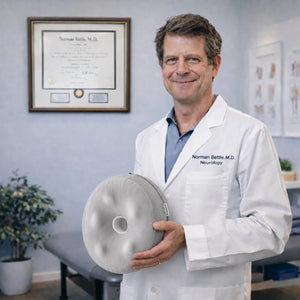
“A holistic approach to managing back pain and improving sleep quality — it addresses the alignment problem at its root instead of masking it.” — Dr. Norman Bettle, MD, Neurologist
Why side sleepers are switching
- Supports more neutral alignment by reducing pelvic rotation
- Contoured cradle stays in place through every position change
- Breathable, high-density foam that supports without flattening out
- Endorsed by a neurologist and a chiropractor for hip and back alignment
- 60-night comfort guarantee — sleep on it for two months, completely risk-free
“First morning in years I got up without that locked-up feeling in my lower back. I genuinely can't believe a pillow did this.”
“I'd tried the stretches, the chiropractor, a new mattress. This was the only thing that actually stayed put and made a difference.”
⚠️ Introductory pricing is limited
Fewer than 26 units remain at the introductory price before it returns to full price.
If you're a side sleeper who wakes up stiff or uncomfortable, your mattress or age may not be the whole story. The position of your knees, hips, and pelvis for hours each night could be playing a bigger role in how comfortably — and how soundly — you sleep. The good news? Supporting better alignment takes only seconds before you go to sleep.