

Table of Contents
- Understanding Why You Toss and Turn at Night
- Step 1: Find the Best Sleeping Position for Side Sleepers
- Step 2: Optimize Your Sleep Environment for Comfort
- Step 3: Master Sleep Hygiene Tips for Better Rest
- Step 4: Manage Stimulants and Diet Before Bed
- Step 5: Use Proper Alignment Support with Benefits of Knee Pillows
- Step 6: Reduce Stress and Anxiety Before Sleep
- Step 7: Build a Consistent Bedtime Routine
- Putting It All Together
- Frequently Asked Questions
Last Updated: October 4, 2026
Understanding Why You Toss and Turn at Night
Restless sleep is frustrating, but you can stop tossing turning with fixable causes. Physical discomfort is a major culprit, when your knees press together during side sleeping, pressure builds in your hips and lower back. Mental stress, anxiety, and racing thoughts also keep your nervous system active when it should rest. Environmental factors like temperature, light, and noise disrupt sleep architecture and your circadian rhythm.
Step 1: Find the Best Sleeping Position for Side Sleepers
Side sleeping supports spinal alignment, but positioning matters significantly.
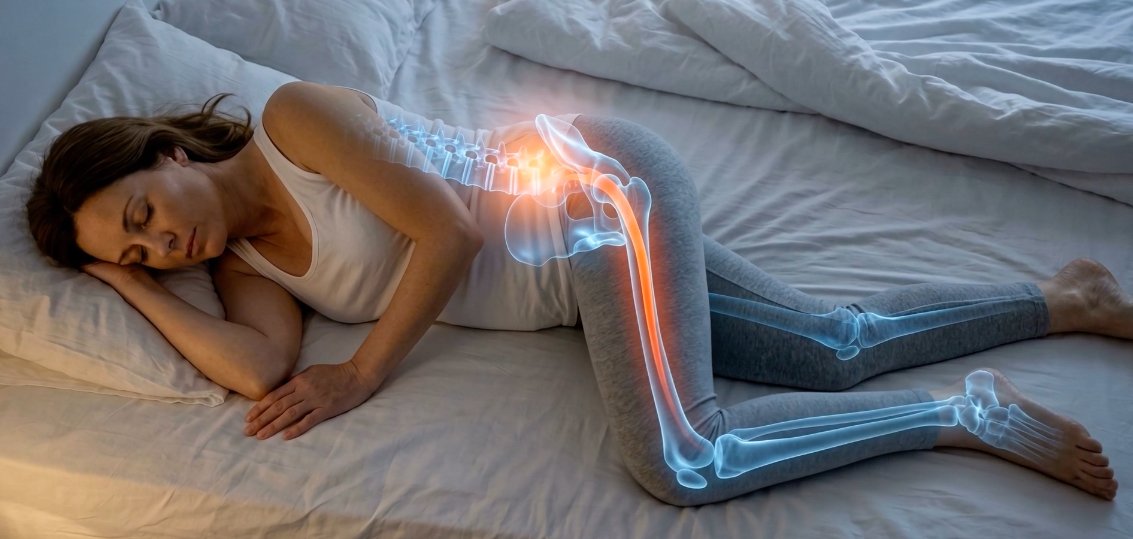
Your spine should form a straight line from head to feet in neutral alignment. Keep your top leg bent slightly, not extended, and rest your bottom arm under your pillow or at your side.
The key is preventing your knees from pressing together. Placing support between your knees maintains proper hip and spinal alignment; without it, your top knee collapses inward, twisting your spine.
A contoured knee pillow like knēNest® is designed for this purpose. Its patent-pending hourglass shape cradles both knees naturally, reducing knee-on-knee pressure and keeping your hips level and spine aligned throughout the night, helping you stop tossing turning.
Key positioning tips:
- Keep your shoulders relaxed and away from your ears
- Position your head so your neck stays neutral
- Place support between your knees to maintain hip alignment
- Avoid sleeping on your stomach, which twists your spine
- If you switch sides, maintain the same alignment on both sides
Step 2: Optimize Your Sleep Environment for Comfort
Your bedroom environment directly affects tossing and turning. Temperature is the biggest factor, your body needs to cool down to sleep. Most sleep experts recommend 60-67°F; use a fan or open a window if your room runs hot.
Darkness is equally important. Use blackout curtains or an eye mask to eliminate light, including small sources from devices and clocks.
Noise disrupts sleep; use white noise machines or earplugs if needed.
A supportive mattress and breathable bedding help maintain alignment and prevent overheating.
Sleep environment checklist:
- Room temperature: 60-67°F
- Complete darkness or eye mask
- White noise or earplugs if needed
- Supportive, well-maintained mattress
- Breathable sheets and pillows
- No screens 30 minutes before bed
- Minimal clutter and calming décor
Your sleep environment should feel like a sanctuary. When your room supports rest, your body needs less repositioning to find comfort.
Step 3: Master Sleep Hygiene Tips for Better Rest
Sleep hygiene, habits that support quality sleep, dramatically reduces nighttime movement. Consistency is foundational: going to bed and waking at the same time every day regulates your circadian rhythm and reduces restlessness.
Your bedtime routine signals sleep is coming. Start winding down 30-60 minutes before bed by dimming lights, lowering temperature, and avoiding stimulating activities.
Avoid screens before bed, blue light suppresses melatonin. Put devices away at least 30 minutes before sleeping.
Exercise during the day improves sleep quality, but avoid intense workouts within 3 hours of bedtime.
Sleep hygiene habits to build:
- Sleep and wake at the same time daily
- Create a 30-60 minute wind-down routine
- Keep your bedroom cool and dark
- Avoid caffeine after 2 PM
- Limit alcohol, which fragments sleep
- Exercise during the day, not near bedtime
- Use your bed only for sleep, not work or screens
Step 4: Manage Stimulants and Diet Before Bed
What you consume directly affects tossing and turning. Caffeine stays in your system for 5-6 hours, so cut it off by early afternoon (including tea, energy drinks, and chocolate).
Alcohol seems to help initially but fragments sleep and increases nighttime movement. If you drink, do so at least 3-4 hours before bed.
Heavy meals close to bedtime disrupt sleep. Eat your last substantial meal 2-3 hours before sleep.
Magnesium-rich foods like almonds, pumpkin seeds, and leafy greens support better sleep. Consult a healthcare provider before starting any supplement.
Pre-bedtime nutrition guide:
- Stop caffeine by 2 PM
- Avoid alcohol 3-4 hours before bed
- Finish eating 2-3 hours before sleep
- Include magnesium-rich foods in your diet
- Stay hydrated during the day, but limit fluids near bedtime
- Avoid spicy or heavy foods at dinner
Step 5: Use Proper Alignment Support with Benefits of Knee Pillows
Knee pillows are among the most effective tools for reducing tossing and turning. When placed between your knees, they maintain hip-level alignment, preventing your top knee from collapsing inward and reducing the need for repositioning.
The benefits of knee pillows for alignment extend beyond comfort. Proper spinal alignment reduces strain on your lower back and hips. Over time, this can help alleviate discomfort from poor sleeping posture.
Not all knee pillows work the same way. Standard pillows placed between the knees often slide, flatten, or shift during the night. You end up repositioning them repeatedly, which wakes you and disrupts sleep.
knēNest® knee pillows are specifically designed for side sleepers. The patent-pending hourglass shape cradles both knees naturally. Built-in airflow channels promote breathability, preventing overheating.
The knēNest® Side Sleeper Alignment Pillow works with your body's natural position. You don't need to adjust your sleep style, the pillow adapts to you. Many side sleepers find that using a knee pillow noticeably reduces their nighttime movement.
For complete spine-to-toe alignment, consider pairing your knee pillow with ankle support. The knēNest® + Orb Spine-to-Toe Alignment System combines knee and ankle support for coordinated positioning from hip to foot. This comprehensive approach addresses alignment at multiple points, further reducing tossing.
knēNest Brisa + Orb Spine-to-Toe Alignment System – Patent Pending →

Why proper alignment support matters:
- Maintains neutral spine position
- Reduces pressure points and discomfort
- Prevents knee-on-knee pressure
- Keeps you in proper position all night
- Reduces the urge to shift and reposition
- Supports deeper, more restorative sleep
If you're a side sleeper who tosses and turns, alignment support is one of the fastest ways to improve sleep quality.
Step 6: Reduce Stress and Anxiety Before Sleep
Mental tension causes physical restlessness. When your mind is active, your body mirrors that activation, leading to more tossing and turning.
Stress and anxiety keep your nervous system in "alert mode." Your body releases cortisol and adrenaline, hormones that prepare you for action. This is useful during the day but counterproductive at night. You need your nervous system to shift into "rest mode" for quality sleep.
Relaxation techniques calm your nervous system before bed. Deep breathing is simple but powerful. Slow, deliberate breathing activates your parasympathetic nervous system, which promotes relaxation. Try breathing in for 4 counts, holding for 4, and exhaling for 4.
Guided meditation helps quiet mental chatter. Even 10 minutes of meditation reduces anxiety and mental activity. Apps and audio recordings make this accessible. Many people find that meditation eliminates the racing thoughts that keep them tossing.
Progressive muscle relaxation works by tensing and releasing muscle groups. This technique reduces physical tension while signaling to your body that it's time to rest. Start at your toes and work upward, tensing each muscle group for 5 seconds, then releasing.
Journaling before bed clears your mind. Writing down worries, to-do items, and thoughts gives your brain permission to stop processing them. This mental offloading reduces the mental activity that causes nighttime restlessness.
Stress-reduction practices:
- Deep breathing exercises (4-4-4 pattern)
- Guided meditation or mindfulness apps
- Progressive muscle relaxation
- Journaling or brain dumps
- Limiting news and social media before bed
- Warm baths or showers
- Calming music or nature sounds
Your mind and body are connected. When you reduce mental stress, your body naturally tosses less. These practices take just 10-20 minutes but deliver significant sleep improvements.
Step 7: Build a Consistent Bedtime Routine
Consistency is one of the most powerful sleep tools available. Your body thrives on predictable patterns. A consistent bedtime routine signals to your nervous system that sleep is approaching.
Your routine should start 30-60 minutes before your target sleep time. Begin by dimming lights and lowering room temperature. These environmental cues trigger melatonin production. Avoid screens during this window, as blue light suppresses melatonin.
Include calming activities in your routine. Reading, gentle stretching, or listening to relaxing music all prepare your body for sleep. These activities occupy your mind with something peaceful rather than stressful.
Consistency matters more than the specific activities. Your body learns to associate the routine with sleep. After a few weeks, simply starting your routine will make you feel drowsy. This is powerful conditioning that improves sleep quality.
A consistent sleep schedule, same bedtime and wake time, regulates your circadian rhythm. Your body's internal clock becomes synchronized to these times. This synchronization reduces nighttime wakefulness and tossing.
Building your bedtime routine:
- Choose a consistent bedtime and wake time
- Start winding down 30-60 minutes before bed
- Dim lights and lower room temperature
- Avoid screens and stimulating content
- Include one or two calming activities
- Keep the routine the same every night
- Track how you feel after 2-3 weeks
The first week of a new routine feels strange. Stick with it. By week two, your body may start responding. By week three, the routine may become more automatic, and sleep quality may improve.
Sleep Improvement Strategy |
Time to Implement |
Expected Improvement |
|---|---|---|
Optimize sleep position |
1-2 nights |
Reduced shoulder/neck tension |
Improve bedroom environment |
1 night |
Better sleep depth |
Establish sleep hygiene habits |
1-2 weeks |
More consistent sleep |
Manage stimulants |
1 week |
Easier sleep onset |
Add knee pillow support |
1-3 nights |
Reduced tossing within days |
Practice stress reduction |
Daily |
Less mental restlessness |
Build bedtime routine |
2-3 weeks |
Deeper, more restorative sleep |
Putting It All Together
Reducing tossing and turning requires addressing multiple factors. Sleep position, environment, habits, diet, alignment support, stress, and routine all work together. You don't need to overhaul everything at once, start with one or two changes and build from there.
The fastest results come from combining proper sleep position with alignment support. When your body is positioned correctly and supported properly, it needs far less repositioning. A knee pillow like knēNest® addresses this immediately.
From there, optimize your environment and sleep hygiene. These changes take minimal effort but compound over time. Within 2-3 weeks of consistent practice, people may notice improvements in sleep quality and a reduction in nighttime movement.
Stress reduction and routine-building take longer to show results, but they're equally important. They address the mental and behavioral factors that cause restlessness. Together, these seven steps create conditions where deep, restorative sleep becomes natural.
Better sleep is within reach. Start tonight with your sleep position and environment. Add a knee pillow for immediate alignment support. Build your routine gradually. Within weeks, you may sleep deeper and wake more refreshed.
The knēNest® Side Sleeper Alignment Pillow is specifically designed to reduce tossing and turning for side sleepers. Its patent-pending hourglass shape maintains proper knee and spinal alignment throughout the night. With our 60-night comfort trial, you can experience the difference proper alignment makes risk-free. Get started with knēNest® and discover how proper alignment transforms your sleep quality.

Frequently Asked Questions
Does sleep position affect how much I toss and turn?
Yes. Side sleeping with proper alignment reduces nocturnal movement significantly. When your spine, hips, and knees are aligned, your body experiences less pressure-related discomfort that triggers repositioning. Poor alignment forces your body to shift constantly to find comfort. Using supportive tools like a knee pillow between your knees helps maintain that alignment throughout the night, reducing the need to toss and turn.
Can physical discomfort cause restless sleep and tossing?
Absolutely. Physical discomfort is one of the primary causes of restless sleep. Knee-on-knee pressure, hip misalignment, and spinal stress create nocturnal wakefulness and frequent movement. Addressing these issues through proper sleep posture and support—such as a contoured knee pillow—can dramatically reduce tossing and turning. Many side sleepers find that reducing pressure points helps them sleep more soundly.
What role does sleep hygiene play in reducing tossing and turning?
Sleep hygiene directly impacts sleep quality and restlessness. Consistent sleep schedules regulate your circadian rhythm, while a cool, dark, quiet environment supports deeper sleep. Avoiding caffeine intake hours before bed and establishing a relaxation routine reduce mental chatter and anxiety that trigger movement. Combined with physical comfort measures, strong sleep hygiene habits significantly decrease nocturnal movement and improve sleep architecture.
How long does it take to stop tossing and turning after making these changes?
People may notice improvement within 1-2 weeks of consistent practice, though individual timelines vary. Your body needs time to adjust to new sleep positions and routines. If you introduce alignment support like a knee pillow, use it consistently and position both knees in the contoured cradle for the intended support. The knēNest Side Sleeper Alignment Pillow comes with a 60-night comfort trial, giving you time to experience the full benefits of proper alignment.