

Table of Contents
- Why Sciatica Gets Worse at Night (and What You Can Do)
- Best Sleeping Position for Sciatica: Side, Back, or Stomach?
- How a Knee Pillow for Sciatica Supports Spinal Alignment
- Sciatica Stretches to Do in Bed Before You Sleep
- Choosing the Right Mattress Firmness for Back Pain and Nerve Relief
- Sleep Hygiene and Bedtime Routine for Chronic Pain
- Common Mistakes That Make Sciatica Worse at Night
- Your Morning Routine After a Night with Sciatica
- Frequently Asked Questions
Last Updated: September 29, 2026
Why Sciatica Gets Worse at Night (and What You Can Do)
Sciatica pain often feels worse at night because lying down changes the pressure on your spine and nerves. During the day, gravity and movement distribute your body weight; at night, your mattress and sleeping position take over, and if alignment is off, the sciatic nerve can get compressed or irritated.
Best Sleeping Position for Sciatica: Side, Back, or Stomach?
The best sleeping position for sciatica is on your side with a pillow between your knees, or on your back with a pillow under your knees. Both positions reduce pressure on the lumbar spine and keep your hips level. Stomach sleeping is the worst option because it arches your back and twists your neck.
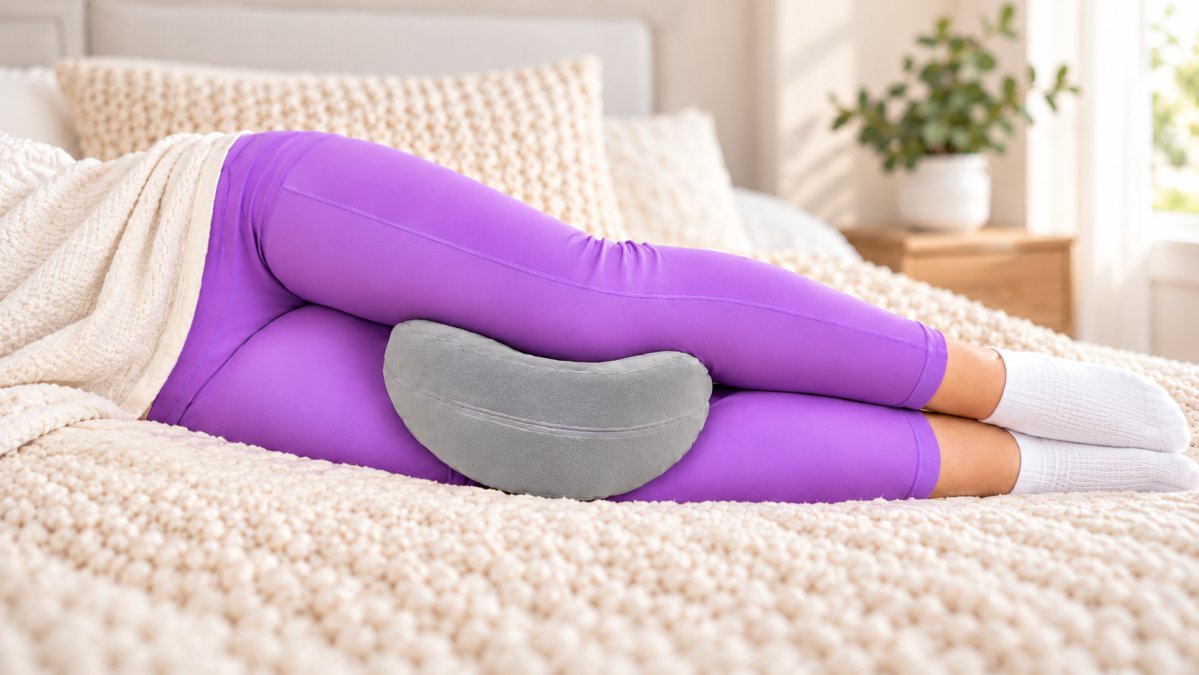
Diagram of the best side sleep with sciatica position using a knee pillow for proper spinal alignment
A quick comparison:
Position |
Spine Effect |
Best For |
Watch Out For |
|---|---|---|---|
Side with knee pillow |
Keeps hips level |
Most sciatica cases |
Pillow sliding away |
Back with knee support |
Flattens lumbar curve |
Herniated disc pain |
Snoring |
Stomach |
Arches lower back |
Rarely recommended |
Neck and nerve strain |
Side Sleeping with a Pillow Between Your Knees
Side sleeping works because it keeps your hips stacked. Without support, your top leg drops forward, rotating your pelvis and pulling on the lower back. A knee pillow fills that gap and holds hip alignment steady.
- Keeps your pelvis square instead of tilted
- Reduces pressure on the sciatic nerve pathway
- Eases lower back pain by limiting spinal rotation
- Works for both left and right side sleepers
Back Sleeping with Knee Elevation and Lumbar Support
Back sleeping takes pressure off the discs, but it can flatten or over-arch your lumbar spine. A pillow under your knees tilts your pelvis into a more relaxed angle, and a small roll under your lower back adds support where the spine curves.
Why Stomach Sleeping Makes Sciatica Worse
Stomach sleeping forces your lower back into an arch and turns your head to one side for hours, straining the lumbar spine and neck at once. It's the position most likely to aggravate nerve compression.
How a Knee Pillow for Sciatica Supports Spinal Alignment
A knee pillow for sciatica holds your hips in a neutral line while you sleep, taking pressure off the lumbar spine and sciatic nerve. The right pillow stays put, keeps its shape, and matches the width of your hips.
- Hourglass shape that cradles the knee instead of rolling away
- High-density memory foam that rebounds night after night
- Airflow channels to keep the pillow from trapping heat
- Hypoallergenic materials for people with sensitive skin
Sciatica Stretches to Do in Bed Before You Sleep
Sciatica stretches in bed before sleep relax your lower back, hips, and glutes so nerve tension eases before you lie down. Five to ten minutes is enough, go slow, and stop if any stretch sends sharp pain down your leg.
Try these before lights out:
- Knee-to-chest: Lie on your back, pull one knee toward your chest, hold 20 seconds. Switch sides.
- Figure-four stretch: Cross one ankle over the opposite knee, gently pull the legs toward you. Hold 20 to 30 seconds per side.
- Pelvic tilt: Lie flat, press your lower back into the mattress, hold 5 seconds, release. Repeat 10 times.
- Cat-cow in bed: On hands and knees, alternate arching and rounding your spine for 30 seconds.
- Supine twist: Lie on your back, drop both knees to one side, hold 20 seconds, then switch.
Choosing the Right Mattress Firmness for Back Pain and Nerve Relief
Mattress firmness for back pain sits in the middle: firm enough to support your spine, soft enough to cushion hips and shoulders. Too soft lets your hips sink and spine curve; too firm and your pressure points take the hit.
- Medium-firm suits most side sleepers with sciatica
- Firm helps back sleepers who need lumbar support
- Memory foam cushions pressure points but can sleep hot
- Hybrid or latex offers bounce plus support
Sleep Hygiene and Bedtime Routine for Chronic Pain
Sleep hygiene matters more with sciatica because pain and poor sleep are locked in a feedback loop. Poor sleep lowers your pain threshold, making your nervous system more sensitive to the same nerve irritation, which then makes it harder to fall asleep the next night. Breaking that loop means addressing both the physical and psychological sides of bedtime.
The pain-sleep cycle, explained
The fear-avoidance trap
A concrete bedtime routine that calms the nervous system
- Set a fixed wake-up time, even on weekends. This anchors your circadian rhythm, which regulates pain sensitivity.
- Dim the lights 90 minutes before bed. Bright light suppresses melatonin, the hormone that helps you sleep and also modulates pain perception.
- Take a warm shower or bath 60-90 minutes before bed. The drop in core body temperature afterward signals sleep onset.
- Do a 5-minute gentle stretch sequence (see the stretches section above) to release physical tension.
- Practice slow breathing, inhale for 4 seconds, exhale for 6 seconds, for 5 minutes. This activates the parasympathetic nervous system, which counteracts the stress response that amplifies pain.
- Keep the room cool (65-68°F), dark, and quiet. Heat and light fragment sleep.
- If you can't sleep after 20 minutes, get up and do something calm in dim light. Don't lie there frustrated, that strengthens the bed-pain association.
What to avoid
- Alcohol: It may help you fall asleep, but it fragments sleep in the second half of the night and increases next-day pain sensitivity.
- Caffeine after 2 p.m.: Caffeine has a half-life of 5-6 hours and can delay sleep onset even if you don't feel wired.
- Heavy meals or spicy food within 3 hours of bed: Digestive discomfort can disrupt sleep and increase overall inflammation.
- Doomscrolling in bed: Screens and stressful content keep your nervous system alert.
The psychological shift
Common Mistakes That Make Sciatica Worse at Night
The biggest mistakes are stomach sleeping, a pillow at the wrong height, and skipping support entirely, each lets your spine twist or arch, keeping the nerve irritated.
Watch for these:
- No knee support while side sleeping, so your hips rotate
- A pillow that's too thick or thin, throwing off hip alignment
- Sleeping on a worn-out mattress that sags in the middle
- Ignoring morning stiffness instead of stretching it out
- Pushing through sharp pain rather than changing position
Your Morning Routine After a Night with Sciatica
The transition from lying down to standing is one of the highest-risk moments for sciatica pain. When you're horizontal, your spine is unloaded and nerves are less compressed; standing too quickly can suddenly load the lumbar spine and send a sharp jolt down your leg. A deliberate morning routine protects that transition.
The safe exit sequence
- Lie still for 60 seconds. Before you move, take a few slow breaths. This gives your nervous system a chance to adjust and reduces the startle response that can trigger muscle guarding.
- Log roll to your side. Keep your knees bent and roll onto the side that's less painful. Use your arms to help, don't twist your spine.
- Bring your knees toward your chest and use your top arm to push your upper body up while swinging your legs off the bed. This keeps your spine neutral instead of flexing forward.
- Sit on the edge of the bed for 30 seconds. Let your back adjust to being upright. Don't stand immediately.
- Stand up by pushing through your legs, not your back. Keep your spine straight and avoid bending forward.
Why this matters
Gentle morning stretches
- Standing extension: Stand with feet hip-width apart, place hands on your lower back, and gently arch backward 5-10 times. This can help centralize pain if you have a disc issue.
- Knee-to-chest on your back: Lie down again and pull one knee toward your chest for 20 seconds per side.
- Walking: Start with 5-10 minutes of easy walking. Movement increases blood flow to the nerves and muscles, which reduces pain sensitivity.
What not to do
- Don't sit straight up from lying down, that flexes the spine and compresses the discs.
- Don't bend forward to put on socks or shoes immediately. Sit down or use a sock aid.
- Don't ignore sharp pain. If a movement sends shooting pain down your leg, stop and try a different approach.
Consistency is key
Frequently Asked Questions
How can I calm my sciatic nerve at night?
Start by sleeping on your side with a pillow between your knees to keep your hips and spine aligned, which reduces nerve compression. Try gentle sciatica stretches in bed before sleep, like knee-to-chest or piriformis stretches. Apply a warm compress to relax muscle tension. Keep your mattress supportive but not too firm. A knee pillow for sciatica can prevent your top leg from dropping forward and irritating the sciatic nerve pathway through the night.
Why is sciatica worse at night in bed?
Several factors converge at night. When you lie down, pressure on the vertebral discs changes, and inflammation can pool around the nerve pathway. Muscles that supported you during the day relax, allowing the lumbar spine to lose neutral alignment. Mattress firmness that does not match your body weight can create pressure points. Plus, without daytime distractions, you notice pain more. Addressing spinal alignment and sleep hygiene together makes a real difference.
Does a knee pillow help with sciatica pain?
Yes, for side sleepers it does. A knee pillow keeps your top leg parallel to the mattress, preventing your pelvis from rotating and your lumbar spine from twisting. That rotation is a common trigger for nerve irritation. Look for a pillow with a contoured shape that stays in place and holds its density. Memory foam with airflow channels helps with both support and temperature. Even back sleepers benefit from knee elevation to flatten the lower back.
What is the worst thing you can do for sciatica?
Sleeping on your stomach is the worst position for sciatica. It forces your lumbar spine into extension and rotates your head to one side, which adds pressure on the nerve pathway. Prolonged sitting without breaks, lifting with a rounded back, and ignoring pain that radiates below the knee also make things worse. If you wake up with sharp pain or numbness that does not improve, see a doctor rather than pushing through it.