

Most knee pillows promise to separate your legs. But if you sleep on your side, separation is only part of the story. The useful question is: where does each knee rest after you settle in? A pillow that feels soft at bedtime may shift, flatten, or leave the upper knee searching for support later in the night.
A well-fitting knee pillow gives both knees a comfortable place to rest. By helping the knees stay vertically stacked, it supports a more natural line through the hips and lower back. That steadier position can make side sleeping feel more comfortable and help you settle into more restful sleep. Here is what to look for and how to use one.
Both knees need a place to rest
When you lie on your side without support, the upper knee can drop forward and inward. The top leg follows, and the pelvis may rotate with it. Giving both knees a stable resting place helps keep them comfortably stacked instead of letting the upper leg pull ahead. That positioning supports natural alignment through the hips and lower back while cushioning direct knee-on-knee contact. You can still move and change sides naturally.
A regular bed pillow may be pleasant to hug, but between the knees it can bunch up or take more space than you want. A flat foam block may keep the knees apart yet offer little guidance about where they should settle. For a closer comparison, see our knee pillow versus regular pillow guide.
Look beyond softness: shape, fit, and stability
Start with the contact points. Is there a comfortable resting area for both knees? Does the pillow sit naturally between your legs when they are gently bent? Can you relax without squeezing it to keep it in place? Your body shape, mattress softness, and preferred leg position all affect the answer.
Then consider the material. Foam should cushion your knees while retaining enough structure to support them. An overly thick pillow may push your legs farther apart than feels comfortable; one that compresses too far may stop providing useful space. A washable cover and breathable construction make the nightly routine easier to maintain.
The knēNest knee pillow uses dual concave sides and a centered cradle to give each knee a defined place to rest. As the responsive memory foam adapts, the contours help keep the knees vertically stacked and discourage the top leg from drifting forward. That is how the design supports more natural hip and lower back alignment. Airflow channels and a soft cover add to the comfort of the setup.
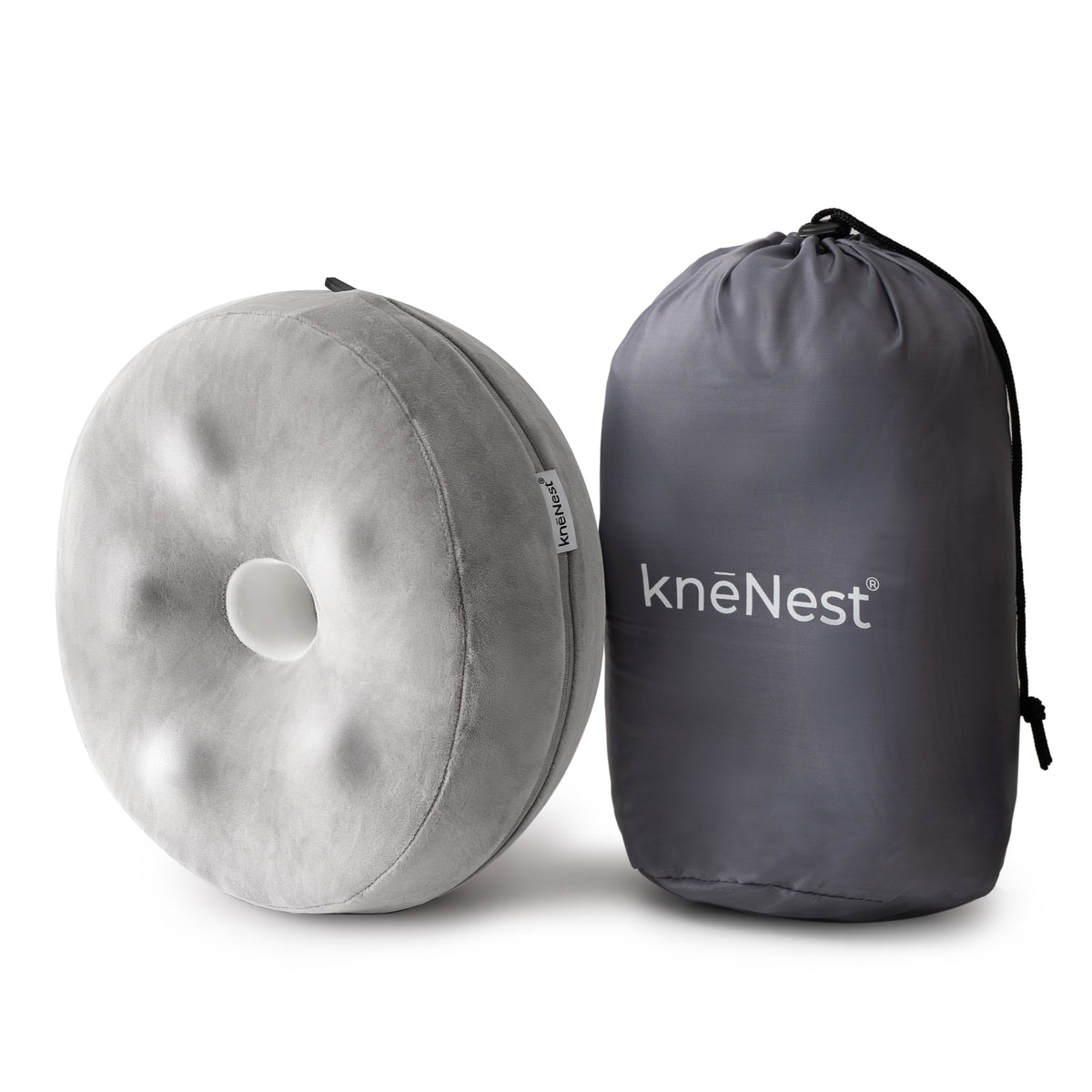
The covered knēNest pillow, shown with its travel pouch. The center recess is visible on the product itself.
A quick fit check before you decide
Sit or lie in your usual side-sleeping position and notice the gap between your knees. You are looking for a support that fills that space comfortably, not the largest pillow you can fit between your legs. If your mattress is plush, your hip may sink farther than it does on a firmer surface, so the same pillow can feel different from one bed to another. Give yourself permission to move the pillow slightly higher or lower until both knees rest naturally. Comfort is personal, and a few small adjustments are more useful than trying to force a textbook pose.
How to place a knee pillow
- Lie on your side in your usual position, with your knees comfortably bent.
- Place knēNest between your knees so each knee settles into a concave side around the center cradle.
- Gently bring your knees together and let the memory foam adapt. Your knees should feel supported and comfortably stacked, without forcing your legs apart.
- Relax into your usual position. Your head pillow and mattress also contribute to how comfortably the rest of your body settles.
Try the position for several nights and adjust it to your comfort. If you change sides, reposition the pillow as needed. You can find a more detailed walkthrough in our knee pillow placement guide.

This product image shows how knēNest sits between the knees and illustrates the foam and airflow construction.
Better knee positioning, more comfortable side sleep
Supporting both knees is a simple way to support the rest of your side-sleeping posture. When the knees rest in a comfortable vertical stack, the upper leg is less likely to fall forward, helping the hips and lower back stay in a more natural line. The cradle also cushions the knees so you can settle in without direct knee-on-knee pressure.
The practical test is how the position feels: do both knees have a place to rest, do your hips feel balanced, and can you relax without repeatedly adjusting the pillow? knēNest is designed to make that setup easy and comfortable, helping you rest more naturally through the night. If you want support farther down your legs, Orb ankle and foot support can help keep the ankles comfortably stacked as part of the same side-sleeper alignment system.
See the knēNest knee pillow and its design details.
See how the original knēNest, Brisa, Orb, and airNest fit different parts of a rest routine in our visual product guide.